MOEF Clearance for Hazardous Waste Import in India: Complete Process Guide (2026)
Learn how to get MOEF clearance for hazardous waste import in India — process, documents, HSMD role, PCB clearance, and common rejection reasons explained.
 corpseed01
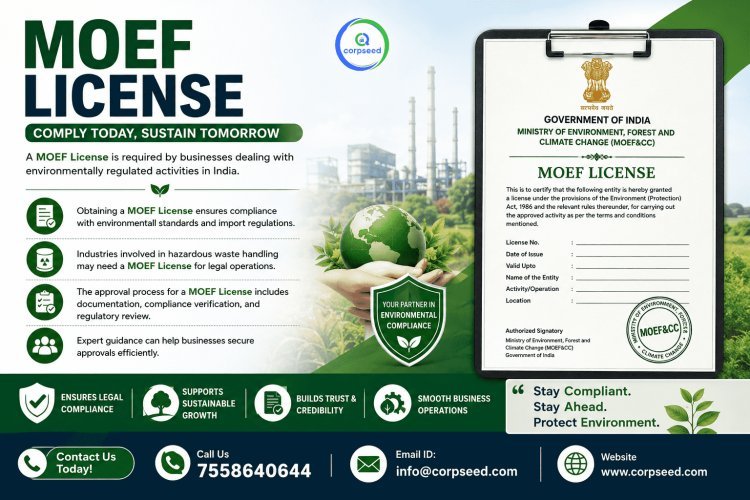
Importing hazardous waste into India isn't as simple as filing customs paperwork. It requires a specific environmental approval — MOEF Clearance — without which your shipment can be held up, rejected, or even penalized at the border.
If your business deals with recyclable scrap metal, used batteries, industrial residues, or other regulated waste categories, understanding this clearance process isn't optional — it's the foundation of legal, uninterrupted operations.
This guide walks you through what MOEF Clearance is, why it matters, and exactly how to get it.
What Is MOEF Clearance?
MOEF stands for the Ministry of Environment, Forest and Climate Change — the central authority responsible for environmental governance in India. MOEF Clearance is the official environmental approval issued by the ministry for activities that fall under environmental regulation, including the import of hazardous waste.
Holding a valid MOEF Clearance confirms that your business meets India's environmental compliance standards and has the systems in place to handle, recycle, or dispose of hazardous material safely — without posing a risk to people or the surrounding ecosystem.
Understanding HSMD: The Body Behind the Approval
Within MOEF, the Hazardous Substances Management Division (HSMD) is the specific wing that reviews and processes hazardous waste import applications. HSMD evaluates every application against India's hazardous waste rules, checking waste category, recyclability, and environmental risk before granting approval.
Knowing this distinction matters — when consultants or government communications reference "HSMD review," they're referring to this core technical evaluation stage of your application.
Why MOEF Clearance Is Non-Negotiable
Hazardous waste, if mishandled, can cause serious environmental and public health damage. MOEF Clearance exists precisely to filter out unqualified importers and ensure only businesses with the right infrastructure and compliance record are allowed to bring such material into the country.
Here's what having a valid clearance does for your business:
- Legal compliance with India's environmental and hazardous waste laws
- Lower risk of shipment rejection at ports and customs checkpoints
- Faster customs clearance, avoiding costly delays and demurrage charges
- Stronger credibility with regulators, partners, and international suppliers
Without it, your shipment can be detained indefinitely — or returned at your cost.
Step-by-Step MOEF Clearance Process for Hazardous Waste Import
Step 1: Document Preparation
Gather all required documents — business registration certificates, existing pollution control permits, technical specifications of your processing facility, and waste handling capacity details.
Step 2: Application Submission
Submit your application along with all supporting documents through the prescribed government channel, following the format and guidelines specified by MOEF.
Step 3: Compliance Verification
Authorities verify whether your business meets applicable environmental laws and hazardous waste management standards before moving the application forward.
Step 4: Technical Evaluation
HSMD evaluates the application based on the waste category, your facility's recycling or processing capability, and the overall environmental impact of the import.
Step 5: Import Permit Issuance
Once the evaluation is cleared, MOEF issues the import permit, allowing your business to legally bring in the specified hazardous waste consignment.
Engaging an experienced compliance partner at this stage significantly reduces the chances of rejection due to documentation gaps or technical errors — and speeds up overall turnaround time.
Pollution Control Board Clearance: A Parallel Requirement
MOEF Clearance alone isn't enough. Businesses must also secure State Pollution Control Board (PCB) Clearance, which verifies that your facility has adequate infrastructure for storing, processing, recycling, or disposing of hazardous waste safely.
In practice, PCB Clearance and MOEF Clearance are closely linked — without PCB approval, MOEF Clearance becomes significantly harder to obtain. It's advisable to pursue both approvals in parallel rather than sequentially, to avoid unnecessary delays.
Special Considerations for Liquid Waste Imports
Liquid hazardous waste carries a higher environmental risk profile compared to solid waste, given its potential for leakage, contamination, and improper disposal. Businesses importing liquid waste products must provide additional documentation, including:
- Proof of leak-proof storage infrastructure
- Detailed processing and treatment protocols
- Safe transportation arrangements
- Final disposal or recycling pathway documentation
Regulatory scrutiny for liquid waste applications tends to be more rigorous, so thorough preparation here is essential.
Common Reasons Applications Get Delayed or Rejected
Understanding common pitfalls can help you avoid them:
- Incomplete or outdated business registration documents
- Mismatch between declared waste category and actual processing capability
- Absence of valid Pollution Control Board clearance
- Inadequate technical specifications of recycling/treatment infrastructure
- Errors or inconsistencies in the submitted application
Working with experienced environmental compliance consultants helps identify and fix these gaps before submission, rather than after rejection.
How Professional Compliance Support Helps
Navigating MOEF Clearance involves multiple regulatory touchpoints, detailed technical documentation, and ongoing coordination with authorities. Professional consultancy support typically includes:
- End-to-end documentation assistance
- Application filing and active case management
- Guidance on environmental norms specific to your waste category
- Support in securing Pollution Control Board clearance
- Regular follow-up with regulatory authorities until approval
This kind of structured support reduces back-and-forth with regulators and significantly shortens approval timelines for businesses unfamiliar with the process.
Frequently Asked Questions
Q1. What is MOEF Clearance for hazardous waste import? It's an environmental approval issued by the Ministry of Environment, Forest and Climate Change, mandatory for businesses importing hazardous waste or related materials into India.
Q2. What does HSMD stand for? HSMD stands for Hazardous Substances Management Division — the MOEF wing responsible for reviewing and approving hazardous waste import applications.
Q3. Is MOEF Clearance mandatory for all hazardous waste imports? Yes. Under Indian environmental law, any business importing hazardous waste must obtain MOEF Clearance before the shipment can legally enter the country.
Q4. Why is Pollution Control Board Clearance also required? PCB Clearance confirms that your facility has adequate infrastructure to safely store, process, recycle, or dispose of hazardous waste — a prerequisite that supports your MOEF application.
Q5. How long does the MOEF Clearance process take? Timelines vary based on waste category and documentation completeness, but engaging compliance experts early typically results in faster processing and fewer rejections.
Final Word
MOEF Clearance is a mandatory checkpoint for any business importing hazardous waste into India — whether it's recyclable scrap, used batteries, industrial residue, or liquid waste products. The process demands precise documentation, technical compliance, and close coordination with regulatory authorities.
Getting it right the first time saves significant cost, time, and operational disruption. Partnering with experienced environmental compliance professionals can make the entire approval journey considerably smoother.