
Why Most LLPs Receive MCA Notices: 7 Compliance Mistakes to Avoid
Meta Description: Struggling with MCA notices after LLP Company Registration? Discover the 7 most common compliance mistakes Indian LLPs make, and exactly how to avoid them. Expert-backed, practical, and up to date.
 juststart407
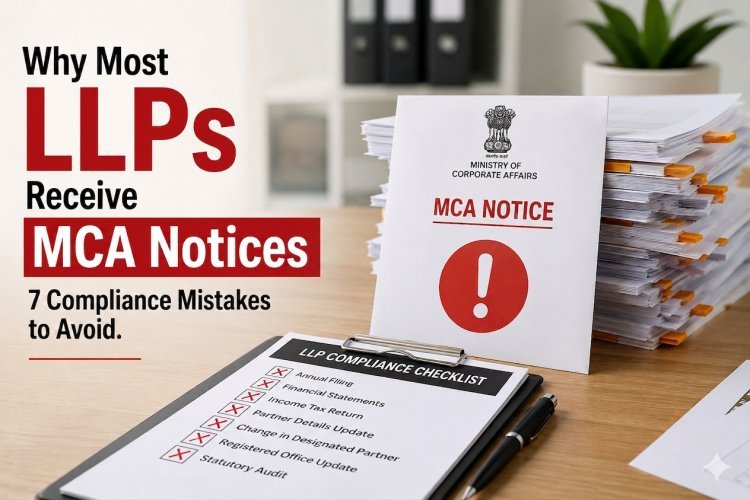
If you've recently completed your LLP Company Registration or are in the process of LLP Registration in India, congratulations, you've made a smart structural choice. A Limited Liability Partnership offers the flexibility of a traditional partnership with the legal protection of a corporate entity. However, what many founders and professionals discover too late is that registration is only the beginning.
A significant number of LLPs registered with the Ministry of Corporate Affairs (MCA) receive compliance notices every year, not because they're running illegal businesses, but because of overlooked procedural obligations. Many of these are entirely avoidable with the right knowledge.
In this guide, we break down the 7 most common compliance mistakes that lead to MCA notices, the penalties involved, and what you must do to stay on the right side of the law.
What Is an MCA Notice, and Why Should You Care?
The MCA (Ministry of Corporate Affairs) is the regulatory body that governs LLP Company Registration Online and all post-registration compliance in India. When an LLP fails to meet its statutory obligations, such as filing annual returns or updating changes in partners, the MCA issues formal notices.
These notices can result in financial penalties, legal action, striking off the LLP from the register, and in serious cases, personal liability for the designated partners. The consequences can be far more damaging than the compliance itself would have been.
A Quick Look at LLP Compliance Obligations
Before diving into the mistakes, here's a snapshot of the key filing obligations every LLP must meet:
|
Compliance Requirement |
Form |
Due Date |
Penalty for Default |
|
Annual Return |
Form 11 |
Within 60 days of closing FY (by May 30) |
₹100 per day of delay |
|
Statement of Accounts & Solvency |
Form 8 |
Within 30 days of 6 months from end of FY (by Oct 30) |
₹100 per day of delay |
|
Income Tax Return (Audit not required) |
ITR-5 |
July 31 each year |
₹1,000 – ₹10,000 |
|
Income Tax Return (Audit required) |
ITR-5 |
October 31 each year |
₹1,000 – ₹10,000 |
|
Change in Partners/Designated Partners |
Form 4 |
Within 30 days of change |
₹100 per day of delay |
|
Change in Registered Office |
Form 15 |
Within 30 days of change |
₹100 per day of delay |
|
LLP Agreement Amendment |
Form 3 |
Within 30 days of amendment |
₹100 per day of delay |
Source: LLP Act, 2008 and MCA circulars. Penalties subject to revision by the MCA.
The pattern here is consistent: delay = daily penalty. And those ₹100-per-day charges accumulate quickly.
Mistake 1: Missing the Annual Return (Form 11) Deadline
This is the single most common reason LLPs receive MCA notices. Form 11 is a summary of an LLP's partners, contributions, and activities for the financial year. It must be filed within 60 days of the close of the financial year, which means by May 30th every year.
Many LLP founders assume this filing is optional for dormant LLPs or those with no business activity. That assumption is wrong. Even a zero-activity LLP must file Form 11. Failure to do so invites a penalty of ₹100 per day with no upper cap.
What to do: Set a calendar reminder every year. If you completed your LLP Registration in India recently, the first Form 11 is due after your first complete financial year ends (March 31).
Mistake 2: Ignoring Form 8 (Statement of Accounts & Solvency)
Form 8 is a declaration by the LLP's designated partners about the financial health of the firm. It includes the Balance Sheet and Profit & Loss account and must be filed by October 30th each year.
Two key sub-mistakes here: First, partners often forget Form 8 entirely when the business has no revenue. Second, LLPs with turnover exceeding ₹40 lakhs or capital contribution above ₹25 lakhs must get their accounts audited before filing, skipping the audit makes the filing invalid.
What to do: Consult a practising Chartered Accountant if your LLP crosses the audit threshold. For below-threshold LLPs, ensure you maintain basic books of accounts so the declaration is accurate.
Mistake 3: Not Updating Partner Changes Promptly
One of the more underestimated compliance traps arises when a partner joins or exits the LLP. Every such change must be reported to the MCA via Form 4 within 30 days of the change.
In practice, many LLPs make verbal agreements about partner changes and update their internal records — but forget to inform the MCA. This creates a dangerous mismatch: the LLP Agreement says one thing, and the MCA registry says another. This can cause complications in banking, legal disputes, and attracts penalty notices.
What to do: Treat any change in partners as a compliance trigger. Prepare the amended LLP Agreement, execute it properly, and file Form 3 (for agreement changes) and Form 4 (for partner changes) within the stipulated 30-day window.
Mistake 4: Not Filing for a "Dormant" LLP
This is perhaps the most widespread misconception among first-time LLP founders: the belief that an LLP with no business activity doesn't need to file returns.
Under the LLP Act, 2008, there is no dormant status equivalent to what exists for companies under the Companies Act. An LLP either exists (and must comply) or it's struck off. There is no in-between.
LLPs that set up the entity for a future business idea and then "pause" frequently end up with years of non-filing penalties stacking up. When they eventually try to reactivate or close the LLP, they face substantial accumulated penalties and legal complications.
What to do: If your LLP is inactive, file nil returns in Form 8 and Form 11 each year. If you have no plans to use the entity, apply for voluntary strike-off under Form 24 to close it cleanly.
Mistake 5: Incomplete or Incorrect LLP Agreement
The LLP Agreement is the founding document of your entity, filed at the time of LLP Company Registration Online. It governs profit sharing, partner rights, decision-making authority, and capital contributions. Many LLPs either skip filing an agreement entirely (defaulting to the model agreement under the LLP Act) or file an incomplete one.
Problems arise when:
- The agreement doesn't reflect actual partner contributions
- Profit-sharing ratios are left ambiguous
- Clauses about partner exit or dispute resolution are missing
- Amendments are made informally without filing Form 3 with the MCA
An improperly maintained agreement is a legal liability waiting to surface, particularly in disputes or during due diligence by investors or lenders.
What to do: Invest time upfront in drafting a comprehensive LLP Agreement with legal assistance. Whenever amendments are needed, file Form 3 within 30 days to keep the MCA records consistent.
Mistake 6: Non-Compliance with GST and Income Tax Obligations
LLP compliance doesn't exist in isolation. MCA filings are just one layer. When LLPs default on GST returns or income tax filings, these lapses often come to the MCA's attention through cross-referencing of databases. The result is a multiplied compliance problem, notices from both the MCA and the Income Tax Department or GST Council.
Common sub-mistakes include:
- Not obtaining GST registration once the LLP crosses the ₹20 lakh turnover threshold (₹10 lakh for specified states)
- Missing quarterly or monthly GSTR filings after registration
- Not linking the LLP's PAN and filing ITR-5 annually, regardless of whether income was earned
What to do: Treat MCA, GST, and income tax compliance as a unified calendar. Many chartered accountants offer bundled compliance packages for LLPs that cover all three simultaneously.
Mistake 7: Forgetting to Update the Registered Office Address
Whenever an LLP moves its principal place of business, this must be reported to the MCA via Form 15 within 30 days of the change. This seems minor but has serious consequences.
If the MCA or a court issues a notice to the LLP's registered address on record and the LLP has moved without updating the registry, it is legally assumed that the notice has been served, even if the LLP never received it. This can result in ex parte orders against the LLP with no opportunity to respond.
What to do: The moment you change your office address, initiate the Form 15 filing immediately. Keep a record of the filing acknowledgement.
How to Stay Compliant After LLP Registration in India
Getting your LLP Company Registration right is important, but maintaining ongoing compliance is what keeps your business protected. Here's a practical annual compliance checklist:
- April–May: File Form 11 (Annual Return) by May 30
- July–October: Prepare accounts, get audited if required, and file Form 8 by October 30
- July/October: File ITR-5 with the Income Tax Department
- All year round: File Form 3 and Form 4 within 30 days of any structural change
- All year round: File GSTR returns monthly or quarterly, as applicable
The Cost of Non-Compliance vs. The Cost of Compliance
To put this in perspective: the professional fee for getting an experienced compliance service to manage your LLP's annual filings (Form 8 + Form 11 + ITR) typically ranges between ₹5,000 and ₹15,000 per year, depending on complexity.
A single year of default on just Form 8 and Form 11, starting from the due date, can accumulate penalties of ₹73,000 in under a year (₹100/day × 2 forms × 365 days). For multi-year defaults, penalties can run into lakhs, far exceeding what compliance would have cost.
Conclusion
Whether you're completing your LLP Company Registration Online today or you've been running an LLP for several years, the message is the same: compliance isn't a bureaucratic burden; it's a legal shield.
The MCA's compliance framework for LLPs is structured around predictable, calendar-driven deadlines. None of the 7 mistakes outlined above are difficult to avoid; they simply require awareness and timely action. Build a compliance calendar, work with a qualified professional, and treat annual filings as non-negotiable business hygiene.